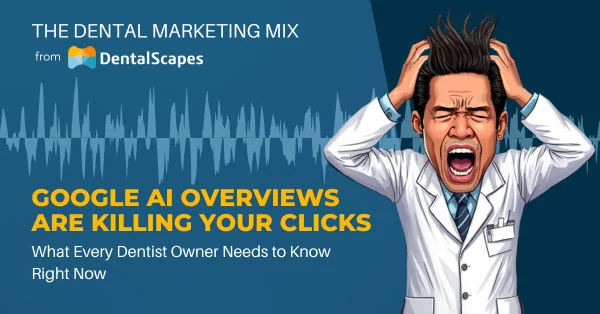
In a recent episode of the Dental Marketing Mix, Dan Brian breaks down what Google AI Overviews are actually doing to dental search — and what practice owners can do about it.
In the most recent episode of the Dental Marketing Mix, DentalScapes co-founder Dan Brian breaks down one of the most significant shifts happening in dental search right now: Google AI Overviews. If your rankings look fine but something still feels off — fewer calls, less website traffic, a general sense that the numbers don’t add up — this episode explains exactly what’s going on and what to do about it.
Your Rankings Are Fine. So Why Is Traffic Down?
Dan opens the episode by naming a pattern he’s been hearing from practice owners repeatedly: “My rankings look fine, but I feel like I’m getting less traffic than I used to. Something’s off.”
That instinct is correct — and the culprit has a name. Google AI Overviews are AI-generated summaries that now appear at the very top of many search results, above paid ads, above the local map pack, above everything. Google synthesizes an answer from multiple sources and presents it directly on the page. The patient gets what they were looking for. They never click. They never reach your website.
Dan notes that organic click-through rates drop by more than 60% when an AI Overview appears on a search results page, and that over 60% of all Google searches now end without a single click to any website. For healthcare queries specifically, that zero-click rate climbs to 83% when an AI Overview is present. That is not a temporary blip — it’s a structural change in how search works.
The Part Most People Are Getting Wrong
Here’s where Dan pumps the brakes on some of the more alarmist coverage circulating about AI Overviews: they are not killing your “dentist near me” traffic.
Dan explains that Google actually tested AI Overviews on local provider searches — queries like “pediatric dentist near me” or “orthodontist in Charlotte” — and then reversed course entirely. Research from BrightEdge confirmed that as of late 2025, those local provider-intent searches show AI Overviews zero percent of the time. Google pulled them back. The traditional local pack — the map with the three listings — still dominates those searches.
As Dan puts it, your local SEO still matters enormously for the queries that drive new patient calls. Anyone telling you otherwise is missing a critical nuance.
What AI Overviews Are Actually Eating
The real damage is happening further up the funnel — to the informational content that used to move patients from curious to ready-to-book.
Dan walks through the data: treatment and procedure queries now trigger AI Overviews nearly 100% of the time. Pain-related queries, 98%. Symptoms and conditions, 93%. Every question a patient has before they’re ready to call — “How long do dental implants last?” “Is Invisalign worth it?” “What’s the difference between a crown and a veneer?” — Google is now answering directly on the results page.
That means the blog posts, FAQ pages, and service page copy your practice invested in to capture patients early in their research journey are getting far fewer clicks than they used to. The content still has value — but the strategy around it needs to evolve.
The Bigger Shift: Patients Are Leaving Google Entirely
Dan points to a second development he thinks is actually larger than the AI Overviews story, and one that gets far less attention: a growing share of patients are bypassing Google altogether.
Instead of typing “dentist near me,” they’re opening ChatGPT, Perplexity, or Google’s AI Mode and asking full questions — the way they’d ask a friend. “Who’s a good dentist near me that takes Delta Dental and does Invisalign?” They want a recommendation, not a list of links.
The problem: when a patient asks ChatGPT that question, ChatGPT typically doesn’t know your practice exists. Recent data shows that over a third of adults have now used AI tools for health information or advice, and roughly 40% of patients are using AI directly to research healthcare providers. The patient journey is changing — and the practices that adapt early are going to have a real head start on those that wait.
What to Do About It
Dan lays out four concrete areas to focus on:
- Reframe your content strategy. Stop treating informational content purely as a traffic play and start treating it as an authority play. Google pulls AI Overview content from somewhere — the sources that get cited are the ones with the most authoritative, well-structured, direct answers. Your content needs a clear answer upfront, not buried in keyword-stuffed filler.
- Structure your website for AI, not just humans. Schema markup — specifically local business schema, FAQ schema, and service-specific schema — helps AI systems understand what your practice does, where you are, and what makes you credible. Most dental websites have none of this.
- Lock down your directory listings. ChatGPT pulls data from Bing, not just Google. If your practice isn’t properly indexed in Bing, you’re invisible to ChatGPT. Inconsistent or incomplete listings on Yelp, Healthgrades, and dental directories make it harder for AI systems to confidently recommend you. Dan also flags a surprisingly common technical issue: many practice websites are inadvertently blocking the bots AI systems use to crawl their content — a simple fix once you know to look for it. Invest in generative search optimization (GEO) before your practice is left behind.
- Answer the detailed questions high-value patients are asking. Patients researching implants, Invisalign, or cosmetic work are asking specific questions — about the consultation process, materials, recovery, and cost ranges. If your site doesn’t answer those questions, you won’t show up in the AI responses those patients are getting. And those are often the patients worth the most to your practice.
TL;DR
- Google AI Overviews appear at the top of search results and answer questions without requiring a click, significantly reducing website traffic from informational queries.
- AI Overviews are not affecting “dentist near me” searches — Google reversed course on local provider queries, and those still show traditional local pack results.
- The real damage is to top-of-funnel content: treatment, procedure, symptom, and cost queries now trigger AI Overviews nearly 100% of the time.
- A growing share of patients are skipping Google entirely and asking ChatGPT or Perplexity for dentist recommendations — and most practices are invisible in those responses.
- The path forward: write content that earns AI citations, add schema markup, clean up your directory listings across Bing and beyond, and make sure your site answers the detailed questions high-value patients are asking.
If you want to talk through what this looks like for your practice specifically — what’s working in your market right now and where your gaps are — that’s exactly what we do at DentalScapes. Book a free strategy call with one of our dental marketing experts! No pressure, no pitch — just an honest conversation about where your practice stands and what would actually move the needle.
Tags

About the Author
Dan Brian
Co-Founder & Director of Client Services, DentalScapes
Dan Brian is co-founder and Director of Client Services at DentalScapes. A recognized early adopter of AI in dental marketing, Dan has been experimenting with and deploying AI tools since before they became mainstream — from AI-assisted content and Generative Engine Optimization (GEO) to predictive campaign analytics. He leads DentalScapes' marketing education programs for practice owners, including The Dental Marketing Mix podcast and The Dental Domination Program book.